
Why Am I Eating When I’m Not Hungry? The 3 Types of Hunger Driving Your Eating—and What to Do About Them
You finished dinner an hour ago.
You’re full. You know you’re full.
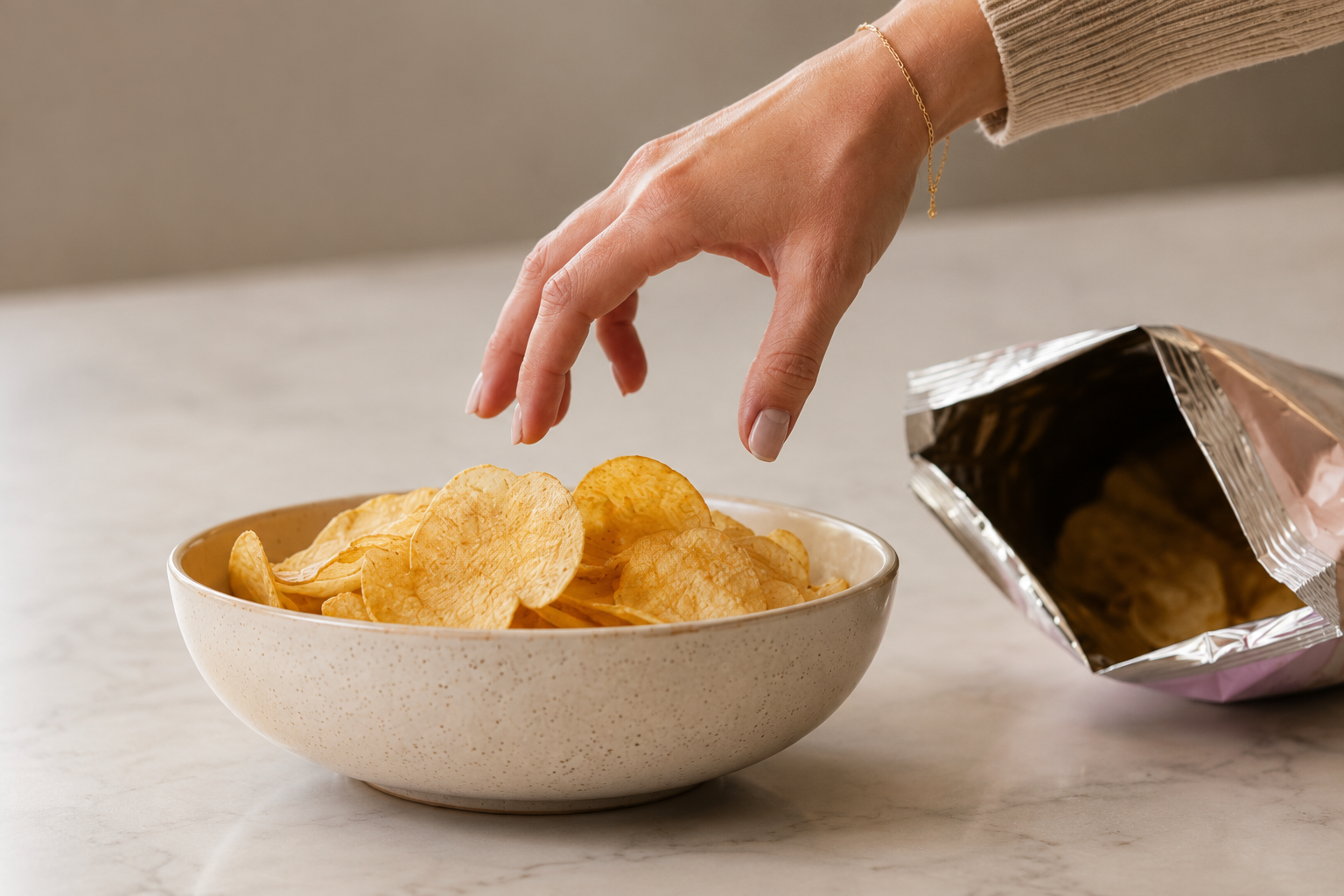
Then you sit down on the couch, someone opens a bag of chips, and suddenly you’re thinking, Those sound really good.
Or maybe it happens around 3 p.m. You’re not exactly hungry, but work has been irritating, your energy is fading, and somehow you find yourself standing in the kitchen looking for something crunchy.
I know this feeling.
Sometimes I catch myself opening the pantry and have to wonder: Am I actually hungry—or am I just looking for something?
Because those are not always the same thing.
We tend to think eating should be simple: we get hungry, we eat, we get full, and we stop.
If only.
Humans eat for many reasons, and our physical need for energy is only one of them. Our emotions, environment, habits, relationships, and the food sitting directly in front of us can all influence whether we want to eat.
One useful way to think about this is to separate hunger into three broad categories:
Physical hunger. Emotional hunger. Social and environmental hunger.
These aren’t rigid medical diagnoses, and real life doesn’t always fit neatly into three boxes. Sometimes several types of hunger show up at the same time.
But learning to recognize what’s actually driving you toward food can change the question from Why do I have no self-control? to something much more useful:
What kind of hunger am I trying to feed?
1. Physical Hunger: Your Body Actually Needs Something
This is the hunger we usually think about.
You haven’t eaten for several hours. Your stomach starts growling. Your energy may drop. Food in general begins to sound good—not just one very specific thing.
Physical hunger is regulated by a sophisticated communication system between your digestive tract, brain, fat tissue, pancreas, and other organs.
Hormones such as ghrelin help signal hunger. Others, including GLP-1 and leptin, are involved in appetite and energy regulation. You don’t need to memorize the hormones. The important point is this:
Your appetite isn’t simply a matter of willpower. There is real biology underneath it.
And what you eat influences how satisfied you feel.
Think about eating a couple of cookies for breakfast versus eggs with vegetables and a piece of fruit. They may both provide energy, but they probably won’t carry you through the morning the same way.
Protein tends to be particularly satiating. Fiber-rich foods add volume and can help meals feel more satisfying. Minimally processed foods also tend to be harder to eat quickly and mindlessly than many ultra-processed foods.
So if you’re genuinely physically hungry every two hours, I wouldn’t start by trying harder to resist food. I’d look at what you’re eating.
Are your meals substantial enough? Are you getting adequate protein and fiber? Are you eating an actual lunch—or surviving on coffee, a handful of crackers, and good intentions until dinner?
Sometimes hunger is simply your body doing exactly what it is supposed to do.
If you’re physically hungry, eating isn’t the problem.
2. Emotional Hunger: When Food Is Meeting a Different Need
Now imagine a different situation.
You had dinner. You’re physically satisfied. Then you get an irritating email.
Suddenly, chocolate sounds fantastic.
That isn’t necessarily physical hunger. But the desire to eat can feel every bit as real.
Food is rewarding. Certain foods activate brain systems involved in pleasure, motivation, and reinforcement. Over time, we can develop strong associations between particular emotions and eating.
Stressful day = wine and snacks. Celebration = dessert. Sad = ice cream. Exhausted = something crunchy on the couch.
And emotional eating doesn’t always come from a dramatic emotion. Sometimes it’s simply: I worked hard today. I deserve this. I’ve done that one too.
The issue isn’t that enjoying food is bad. The issue is when food becomes our automatic response to something food can’t actually fix.
The chips may give you a few pleasurable minutes. They won’t solve the fact that you’re lonely, bored, angry, overwhelmed, or completely exhausted.
So instead of immediately asking Should I eat this?, try asking:
What am I actually needing right now?
Maybe you genuinely want the chocolate. Then make that decision consciously and enjoy it. But maybe what you actually need is to close the laptop, call a friend, go outside for ten minutes, or admit that you’re exhausted and go to bed.
That pause matters. It turns a reaction into a choice.
3. Social and Environmental Hunger: When Something Else Tells You to Eat
You’re not thinking about cookies. Then you walk into the break room and see them. Now you want one.
Or your husband opens a bag of chips while you’re watching television. Suddenly chips sound amazing.
Nothing changed physiologically in those few seconds. Your environment changed.
Sight, smell, availability, routines, portion size, and watching other people eat can all influence how much we want to eat.
And sometimes the cue is even simpler: the clock.
It’s noon, so you eat lunch—even though you’re not hungry. Three o’clock rolls around, so you automatically start looking for a snack. Maybe television and snacking have become so linked that one triggers the other.
That’s a habit, not physical hunger.
There are practical reasons to eat on a schedule. Maybe noon is your only chance before a packed afternoon. But there is value in knowing the difference between I’m hungry and This is when I normally eat.
If you never notice the difference, the routine makes the decision for you.
Our modern food environment makes these cues harder to ignore. Highly processed foods are accessible, convenient, and often designed in combinations of sweetness, salt, fat, flavor, and texture that make them easy to keep eating.
Think about how different your behavior might be if you had to bake cookies from scratch every time you wanted one versus having an open package sitting six feet away.
Same person. Same willpower. Very different environment.
Your surroundings shape your eating more than most of us realize.
Sometimes All Three Show Up at Once
Real life gets messy.
Imagine you skipped lunch because work was crazy. By 4 p.m., you’re genuinely hungry, you’re stressed, and then you walk into the kitchen and see a bag of chips sitting on the counter.
Physical hunger. Emotional hunger. Environmental cue.
All three just walked into the kitchen with you.
And now we’re expecting willpower to solve the whole thing.
This is why telling someone to “just have more discipline” is rarely useful. You needed lunch. You needed a way to decompress. And the chips were the easiest option in sight.
Those are three different problems. They need three different solutions.
Ultra-Processed Food Makes the Lines Even Blurrier
This is where our modern food environment deserves some attention.
In a 2019 NIH-led study published in Cell Metabolism, people eating an ultra-processed diet consumed about 500 more calories per day than when they ate a minimally processed diet, despite the diets being designed to match for several nutrients.
That doesn’t prove that every processed food makes us overeat. But it does tell us something important:
How food is made and presented can influence how much we eat—not just our conscious decision to eat it.
Highly rewarding food can interact with all three types of hunger. You’re physically hungry and it’s easy to eat quickly. You’re stressed and it provides immediate pleasure. You’re not hungry at all, but you see it and suddenly want it.
That is the food environment we’re trying to navigate every day.
So What Do You Do About It?
I’m not going to tell you to ask yourself 17 questions every time you want a snack.
Try one:
What kind of hunger is this?
If it’s physical hunger, eat. And if you’re constantly hungry between meals, look at whether your meals are actually satisfying you. Are you getting enough protein, fiber, and overall food?
If it’s emotional hunger, identify what else is going on. Stress? Boredom? Exhaustion? Reward? Food might temporarily change how you feel, but it won’t address what made you reach for it in the first place.
If it’s social, environmental, or habitual, identify the trigger. Did you see the food? Did someone else start eating? Is it simply 3 p.m. and that’s when you always snack?
Then change what you can. Put foods you tend to mindlessly eat out of sight. If you’re not hungry at noon and your schedule allows it, wait. If television automatically means snacks, change the routine.
Stop relying on willpower to repeatedly overcome an environment and routine that trigger the same behavior. Make the behavior easier to change instead.
And if you do find yourself eating when you weren’t hungry, skip the Why do I keep doing this? I have no willpower.
Ask instead: What made me want to eat just now?
One creates judgment. The other gives you information.
And once you understand what’s driving the behavior, you have something you can actually change.
Pick one pattern. Experiment with one change. See what happens.
Because sustainable behavior change rarely starts with another rigid food rule. It starts with understanding why you’re doing what you’re doing.
So the next time you find yourself standing in front of the pantry thinking, Why am I even here?, ask:
What kind of hunger brought me here?
That one question may tell you more about your eating than another list of foods you’re supposed to avoid.
And if you know what you want to change but keep finding yourself pulled back into the same eating patterns, that’s exactly where coaching can help. Book a free discovery call and let’s talk it through—together, we can identify what’s actually driving the behavior and build strategies that work in your real life, not just when everything goes perfectly.